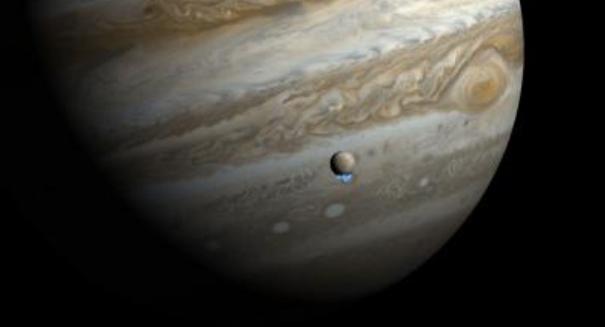
Europa is already believed to contain a liquid ocean underneath its icy crust.
According to a news release from the ESA, Hubble has spotted geysers taller than Mt. Everest on Jupiter’s moon Europa. The Sydney Morning Herald reports that these geysers are more than 200 kilometers high.
Europa is already believed to contain a liquid ocean underneath its icy crust, suggesting that the moon is one of the primary targets in the continuous search for habitable worlds. This new discovery is the first observational proof of water vapor being discharged off the moon’s surface.
“The discovery that water vapor is ejected near the south pole strengthens Europa’s position as the top candidate for potential habitability,” posited lead author Lorenz Roth of the Southwest Research Institute. “However, we do not know yet if these plumes are connected to subsurface liquid water or not.”
This finding makes Europa only the second moon in the Solar System proven to have water vapor plumes. In 2005, plumes of water vapor and dust were spotted by Cassini erupting off the surface of Saturn’s moon Enceladus.
The plumes were found by Hubble observations last December. The Space Telescope Imaging Spectrograph picked up faint ultraviolet light from an aurora located at the moon’s south pole. This aurora is caused by Jupiter’s intense magnetic field, which forces particles to achieve such extreme speeds that they can split the water molecules in the plume when they hit them, developing oxygen and hydrogen ions which leave behind evidence of their presence in the colors of the aurora.
Roth thinks that long cracks on Europa’s surface might be venting water vapor into space. It is unknown how deep inside Europa’s crust the source of the water may be located.
The researchers discovered that the intensity of the plumes differs with Europa’s orbital position. Active geysers have only been spotted when the moon is most distant from Jupiter. The researchers could not observe any indication of venting when Europa is positioned closer to Jupiter.
Long fractures in the ice crust could undergo stress as gravitational tidal forces push and pull on the moon, opening vents at greater distances from Jupiter.
The study’s results are described in a recent issue of the journal Science Express.


Leave a Reply