The hologram theory is, for now, a stopgap that explains string theory without the observation of the gravitron particle
Holograms are a result of holography, a technique which enables three-dimensional images to be made. It involves the use of a laser, interference, diffraction, light intensity recording and suitable illumination of the recording. They’re also, apparently, our Universe. That’s right, according to simulations, what we consider our Universe qualifies (though not in the technical sense) as a hologram. Does that mean you yourself are a hologram, browsing the internet (which is also a hologram) on a computer (which, surprise, may also be a hologram)? Unlikely, but who can be sure (holograms, probably)?
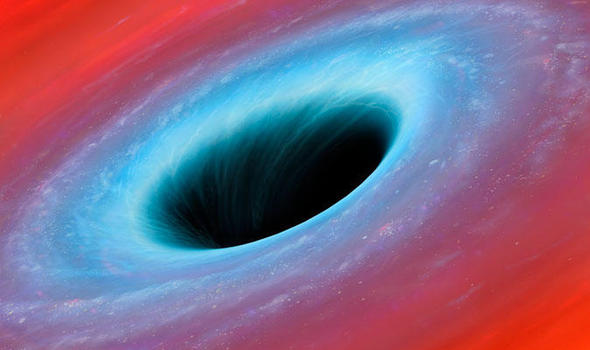
The theories and simulations suggest that properties at a black hole’s event horizon mean that the world we occupy is simply a projection, a representation, of another, unseen Universe where actual events take place. Specifically, the explanation resolves a conflict between Einstein’s theory of gravity and quantum physics, which which would prove string theory.
In 1997, theoretical physicist Juan Maldacena proposed a model of the Universe in which gravity arises from infinitesimally thin, vibrating strings could be reinterpreted in terms of well-established physics. If true, that means our Universe is essentially a hologram, flatter and without gravity.
“The work culminated in the last decade, and it suggests, remarkably, that all we experience is nothing but a holographic projection of processes taking place on some distant surface that surrounds us,” wrote physicist Brian Greene, of Columbia University. “You can pinch yourself, and what you feel will be real, but it mirrors a parallel process taking place in a different, distant reality.”
Greene has lots more to say on the subject, and the content is admittedly pretty dense for non physics buffs. To better explain the hologram theory, he draws from Plato’s Allegory of the Cave, where cave dwellers’ perception of the world was based solely on the shadows of it that flickered across the cave walls – a faint inkling of a much richer world. The allegory may be more than just a metaphor, it turns out.


Leave a Reply