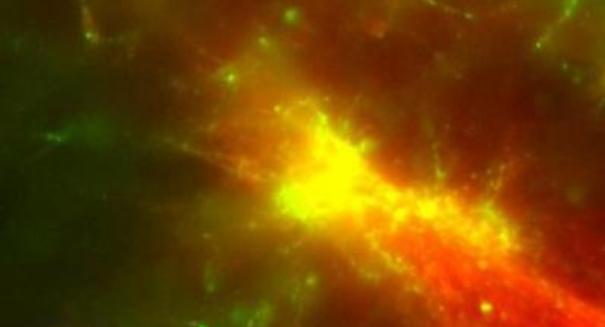
The system can build its own network of tracks stretching many micrometers in length.
According to a news release from the University of Oxford, researchers at Oxford and Warwick University have created small self-assembling transport networks, power-driven by nano-scale motors and governed by DNA. The system can build its own network of tracks stretching many micrometers in length, carry cargo across the network and even take down the tracks.
Researchers were encouraged by the melanophore, utilized by fish cells to manage their color. Tracks in the network all originate from a central location just like the spokes of a motorcycle wheel. Motor proteins move pigment around the network, either focusing it in the center or diffusing it throughout the network. Focusing pigment in the center results in lighter cells, as the encircling space is left barren and transparent.
The system created by the researchers is very much alike, and is constructed from DNA and a motor protein known as kinesin. Power-driven by ATP fuel, kinesins journey along the micro-tracks transporting control modules constructed from short strands of DNA. “Assembler” nanobots are constructed using two kinesin proteins, giving them the ability to transport tracks around to make the network, whereas the “shuttles” only require one kinesin protein to move along the tracks.
“DNA is an excellent building block for constructing synthetic molecular systems, as we can program it to do whatever we need,” noted Adam Wollman, of Oxford’s Department of Physics, in a statement. “We design the chemical structures of the DNA strands to control how they interact with each other. The shuttles can be used to either carry cargo or deliver signals to tell other shuttles what to do.”
“We first use assemblers to arrange the track into ‘spokes’, triggered by the introduction of ATP,” Wollman added. “We then send in shuttles with fluorescent green cargo which spread out across the track, covering it evenly. When we add more ATP, the shuttles all cluster in the center of the track where the spokes meet. Next, we send signal shuttles along the tracks to tell the cargo-carrying shuttles to release the fluorescent cargo into the environment, where it disperses. We can also send shuttles programmed with ‘dismantle’ signals to the central hub, telling the tracks to break up.”
This demonstration utilized fluorescent green dyes as cargo, but the same techniques could be put into use with other compounds. As well as color alteration, spoke-like track systems could be utilized to accelerate chemical reactions by bringing the required compounds together at the central point. In general, utilizing DNA to manage motor proteins could enable the creation of more advanced self-assembling systems for a number of applications.
The study’s findings are discussed in greater detail in the journal Nature Nanotechnology.
What do you think of this development? Start a conversation by sounding off in the comments section.


Leave a Reply