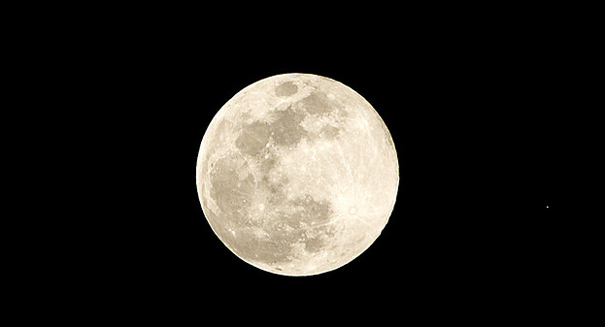
NASA returns to the moon to study its atmosphere.
Today at 11:27 p.m., NASA will be launching the Lunar Atmosphere and Dust Environment Explorer (LADEE) spacecraft from Wallops Flight Facility on Wallops Island, Va. The brand new spacecraft will make its debut mission to the moon to investigate the mysterious lunar dust and ultra-thin atmosphere. Scientists hope the information gathered from this mission could offer insight regarding astronaut health and in situ resource utilization needed for lunar habitat development.
“Sometimes, people are a little taken aback when we start talking about the lunar atmosphere because, right, we were told in school that the moon doesn’t have an atmosphere,” said Sarah Noble, NASA program scientist. “It does. It’s just really, really thin.”
NASA has sent approximately 40 spacecrafts to the moon, and all but one of them launched from Cape Canaveral. The most memorable launch were the manned Apollo flights of the late 1960s and early 1970s, and the most recent were the twin Grail spacecrafts launched two years ago this weekend. The only mission not to come from Cape Canaveral was Clementine, a military-NASA venture that blasted off in 1994 from Southern California.
The Minotaur V rocket—an eight-story, five-stage rocket—will launch the LADEE spacecraft into a highly elliptical orbit where it can phase and time its trajectory burn to the moon. LADEE will take around two and a half months to get to the moon, where it will spend another 100 days orbiting the Earth’s satellite and conduct science experiments at an altitude of about 30 miles (50 km). Finally, the orbiter will impact the lunar surface upon completing its science mission.
The Lunar Dust Experiment will capture and analyze any lunar dust particles that may be in the moon’s atmosphere. LADEE’s Ultraviolet and Visible Light Spectrometer instrument will analyze light to determine the lunar atmosphere’s composition. Meanwhile, LADEE’s Neutral Mass Spectrometer will measure variations in the moon’s atmosphere over time. Instead of radio transmissions, LADEE will use lasers to create a broadband transmission with Earth.
Weather forecasts look clear for tonight launch, NASA officials said, adding that there is a near-perfect 95 percent chance of good weather over the launch pad. Depending on local weather conditions, the nighttime launch could be visible to millions of observers all along the U.S. East Coast.
You can watch the LADEE launch live on SPACE.com beginning at 9:30 p.m. EDT (0130 GMT), courtesy of NASA TV. Those living on the East Coast in the U.S. may be able to see the rocket launch rise into the night sky.


Leave a Reply