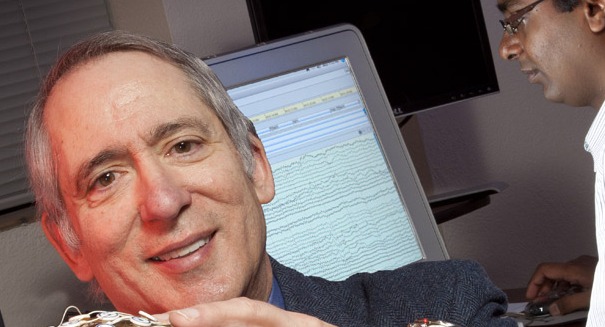
Dennis Molfese has established himself as an expert in the area of brain recording techniques that investigate the link between the brain and behavior.
Scientists only know partially what the brain is capable of, but the question of why and how has been a driving force for world-renowned brain expert Dennis Molfese.
Molfese is the director of the University of Nebraska-Lincoln’s Center for Brain, Biology and Behavior. He has established himself as an expert in the area of brain recording techniques that investigate the link between the brain and behavior. Molfese’s reputation has been built on his superior investigative skills, talent of acquiring grant support and his multi-discipline work strength. Now, he has turned his focus to galvanizing the university’s research efforts by bringing together researchers from different disciplines to study complex social dynamics.
“We’re going to be with UNL faculty looking at a host of issues that really cut across every discipline in the university. No imaging center in the world is doing that,” Molfese says.
While some 22,000 feet is under construction as part of the East Stadium expansion, Molfese and his lab are set up in Nebraska Hall. From this temporary lab he has already trained 130 faculty members, from different areas of the university, as a means of introducing them to brain imaging research and to hopefully generate new ideas for ways the technology could be used in their respective fields of study. Faculty members that choose to continue with the project will receive advanced training and coaching, as well as help designing experiments that will place them in a position to receive grant funding for research support.
“If they run with it, I have no question in my mind that their publications will be successful, that their reputations will take a quantum leap because again, they’ll be doing things nobody else has done in their field,” he says.
The centerpiece of the lab is the functional magnetic resonance imaging machine (fMRI). The new machine is expected to arrive at the campus this winter. It has the ability to track blood flow within areas of the brain and detect subtle changes that have been linked to behavior. The fMRI, as well as other technologically advanced equipment, is being partially paid for by a $1.2 million grant from the Nebraska Research Initiative.
Memorial Stadium will support the new center’s partnership with University of Nebraska-Lincoln athletics as they study the effects of concussions and other sports-related issues.
The effort has gained momentum due to the university’s status as a member of the Big Ten Conference and Committee on Institutional Cooperation (CIC). Molfese has been chosen to coordinate research across 13 CIC affiliated institutions in an attempt to better understand the long term effects of concussions.



Leave a Reply